

Tonle Sap
Solo travel dispatches from a midlife woman with an idea of a plan.

Fourth in a series called An Idea of a Plan.
It was fairly early but already warm, the sun punishing in that particular Cambodian way that doesn’t ask permission. I had my UV umbrella but felt embarrassed to use it in front of Sitha — my friend, driver, and cultural exchange partner for the day — so I left it folded. I would regret that later. The Cambodian tropical sun is not something you negotiate with.
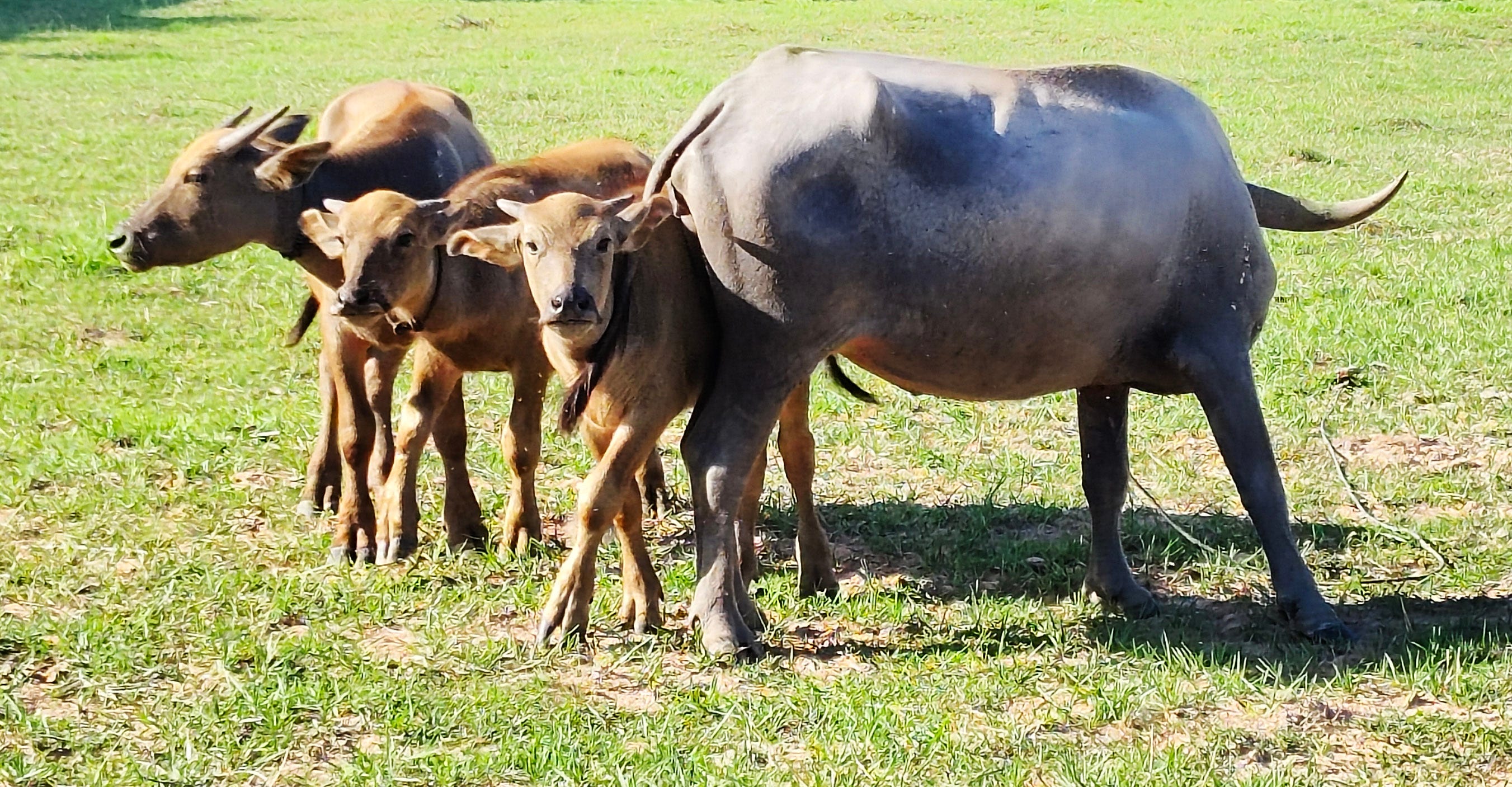
Our first stop was at the side of a road I didn’t know the name of, in a field I had no right to be in. I’d told Sitha I desperately needed to see baby water buffaloes. In the distance I could see three babies and two mamas, and my reluctance to trespass on someone else’s land evaporated immediately.
“There aren’t any snakes in this field, are there?” I asked.
“Don’t worry. They’re tied with a rope and a stake in the ground.”
He meant the buffalo, not the snakes.
When I asked again about the goddamn snakes, he said they’d be in the bushes if there were any. Relieved but still watchful, I continued walking.
I approached slowly, cautious of the mamas and their very large horns, taking as many photos as I could. I have a long-held obsession with cows of all kinds, and water buffalo occupy a special place in my heart, partly because they’re so cute, and partly because I will never get over the fact that they can swim underwater. Getting close enough to watch them raise their noses and flatten their heads — a position that’s nearly impossible to describe unless you’ve seen it — was pure joy. The babies weren’t as small as I’d hoped, but they were still visibly smaller than their mamas, each with different coloring that I found beautiful. Someday I am going to raise a water buffalo from a baby to old age, and it will be the most spoiled water buffalo in Southeast Asia, and we will go swimming every single day.
As we walked back to the remorque, Sitha stopped to pick up a round, dark, coconut-looking thing I had never paid attention to before. Through his developing English (which is, I’ll note, considerably more than the eight words I know in Khmer), he explained it was the fruit used to make palm sugar. He described the process of turning the stringy, fibrous insides into a sweet syrup, then broke it open for me.
I expected it to smell overripe or rotten. I was completely wrong.
The aroma that came out of that broken fruit was deep, layered, and unlike anything I’ve encountered. I kept leaning back in to smell it as he kept explaining. I drew the line at tasting it as I am cursed with a weak stomach and a long list of random food allergies, but Sitha ate some and declared it very good. I believed him.
We bypassed the next village. The street market was in full swing and loud in a way that hit me before I even stepped down from the remorque. Sitha noticed my hesitation and pulled back onto the main road without a word, then turned suddenly onto a dirt path cutting through the countryside. Nothing but rice fields and scattered houses in every direction.
“This field is full of rice that has been growing for only two weeks,” he said. “Can you smell it?”
I hadn’t known rice crops had a smell. They have a clean, faintly sweet, living smell. We stayed there longer than I expected, talking about everything: how rice grows, how the planting cycles work, how the harvested rice is processed offsite. At some point the conversation led to unexpected topics and Sitha began explaining the tradition of paying a dowry to a bride’s family before marriage. He called it, plainly, buying a wife.
I felt the sentence land, so without external judgment, I asked more questions. What I came to understand — through an honest conversation with a man who clearly loves and respects the woman he married — is that the dowry tradition in Cambodia functions primarily as financial support for the bride’s family rather than as an ownership transaction, at least from where Sitha stands. To be quite honest, something like this makes my blood boil, I can’t pretend it doesn’t, but I also know that my framework for thinking about this was built somewhere else entirely and that he used the words he knows in a language not his own. Context doesn’t erase discomfort. It just makes room for understanding alongside it, even when understanding isn’t the same as acceptance.
I will say: Sitha is one of the more thoughtful men I’ve met in Cambodia. He’s kind, genuinely curious, and visibly anxious about his children’s futures in a way that I recognize across every culture I’ve moved through. It’s abundantly clear that he cares.
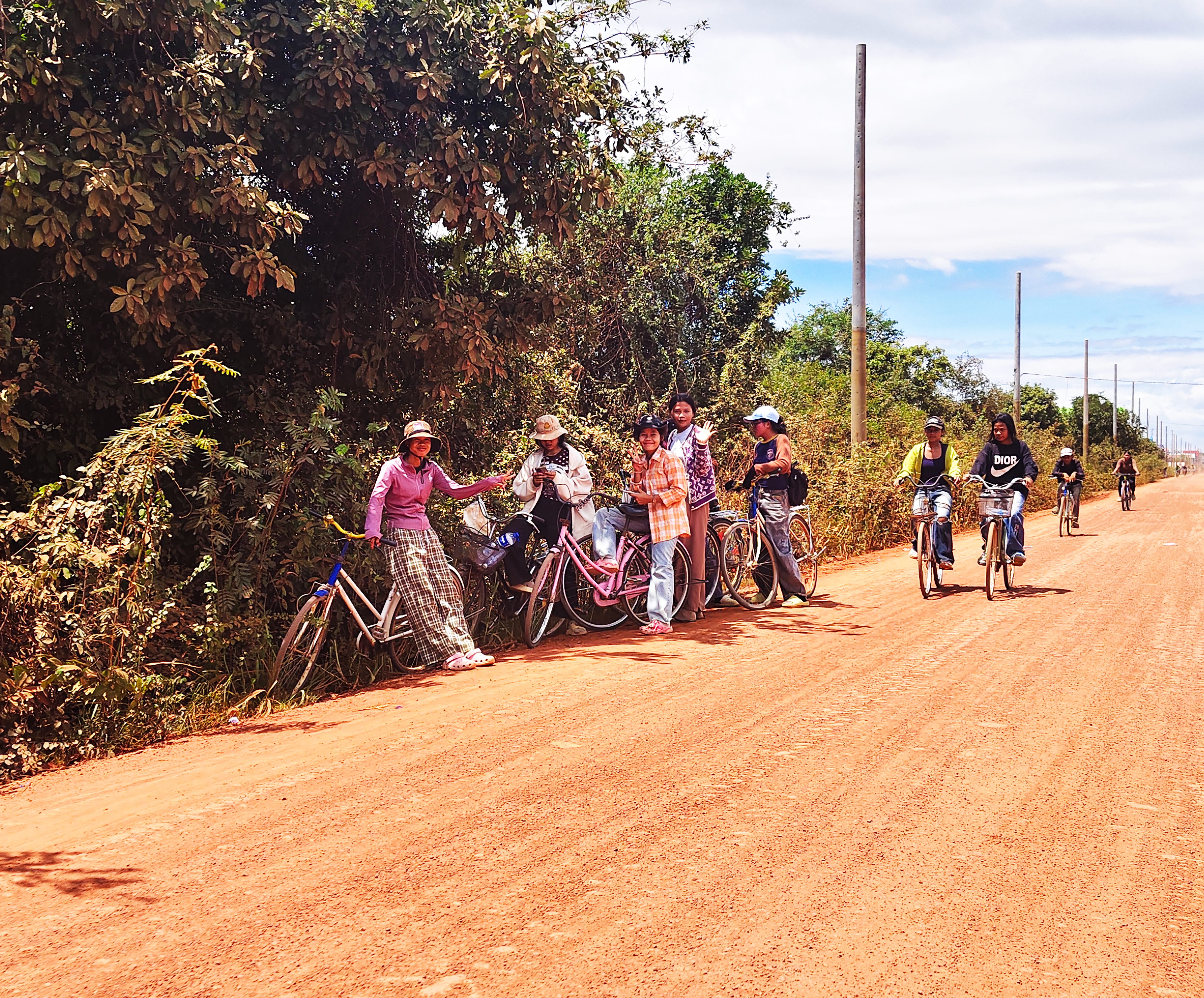
The plan for the day, as far as I knew, was a boat ride on Tonle Sap and a festival. I didn’t know the details of either. After stopping at a ticket booth in the middle of nowhere, we started seeing cyclists. A few at first, then — after a short sharp incline that marks the hard boundary between always-dry land and land that floods annually — more, coming toward us in waves.
And not the kind of cyclists you’re imagining. Not middle-aged men in head-to-toe spandex with aerodynamic helmets and wrap-around sunglasses. No. I’m talking about kids and brave adults in long sleeves, jackets, and furry bucket hats, riding Cambodian-style bikes with baskets on the front, in the middle of a hot and humid afternoon. It was one of those sights that stops your internal monologue cold. I took a metric ton of photos.
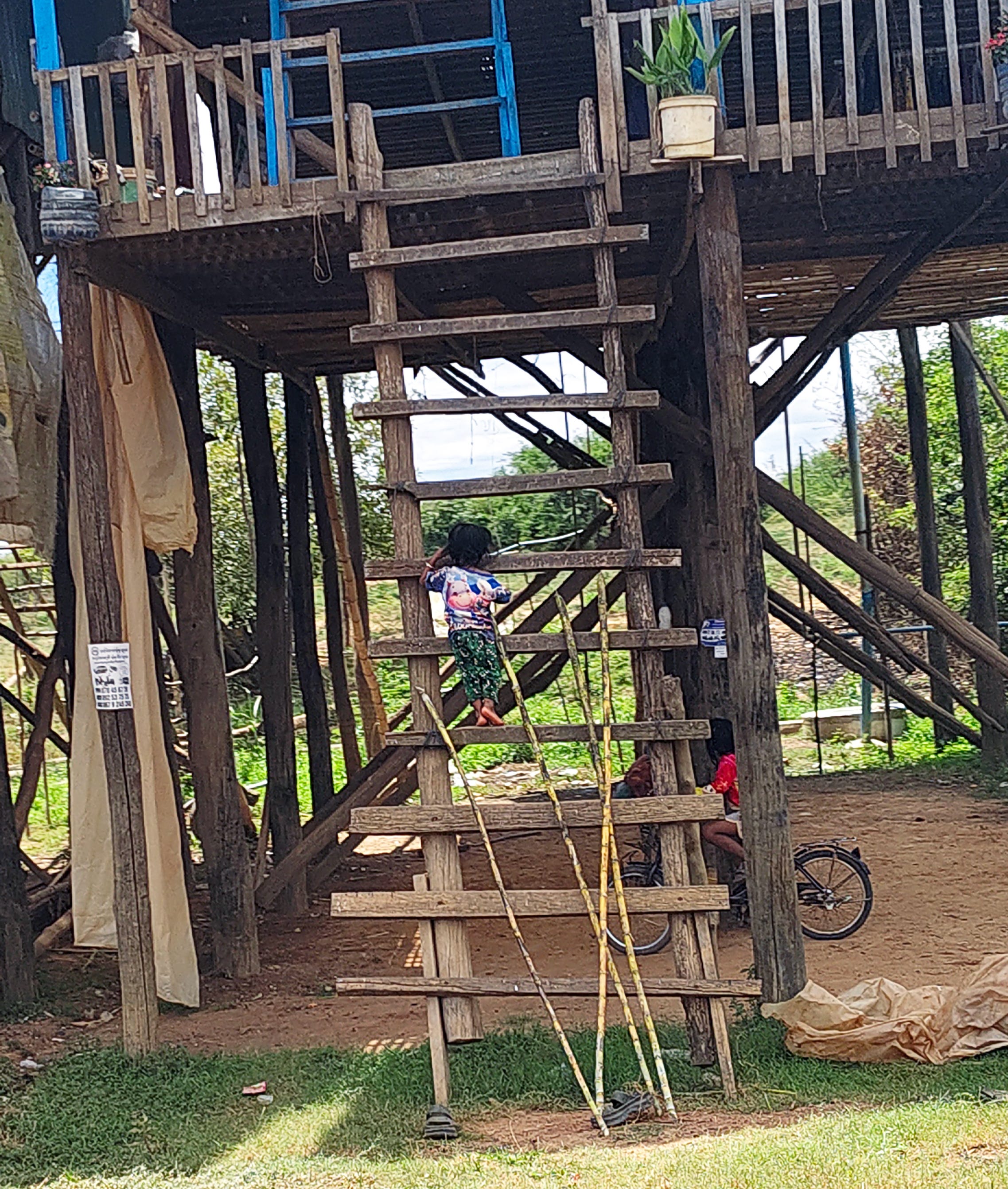
Alongside the cyclists, the stilted village of Kampong Phluk began to emerge. It’s built on stilts because the lake rises by roughly 26 to 33 feet every green season (the local term used for wet season), submerging them completely and creating the illusion that the homes are floating. In the dry season, with the stilts exposed, the buildings look like teenagers who just hit a growth spurt — all legs, still figuring out how to carry themselves. The roads we’d driven through would be waterways by September. It’s hard to imagine, but I can’t wait to return for the opposite perspective.
Sitha parked the remorque and paid a nearby eight-year-old to watch it. This kid had the smoothest skin I’d seen in years. He wanted to practice his English so we talked about his school and his family. I asked if he’d trade his curly black hair for my straight gray hair.
He said yes. We all laughed.
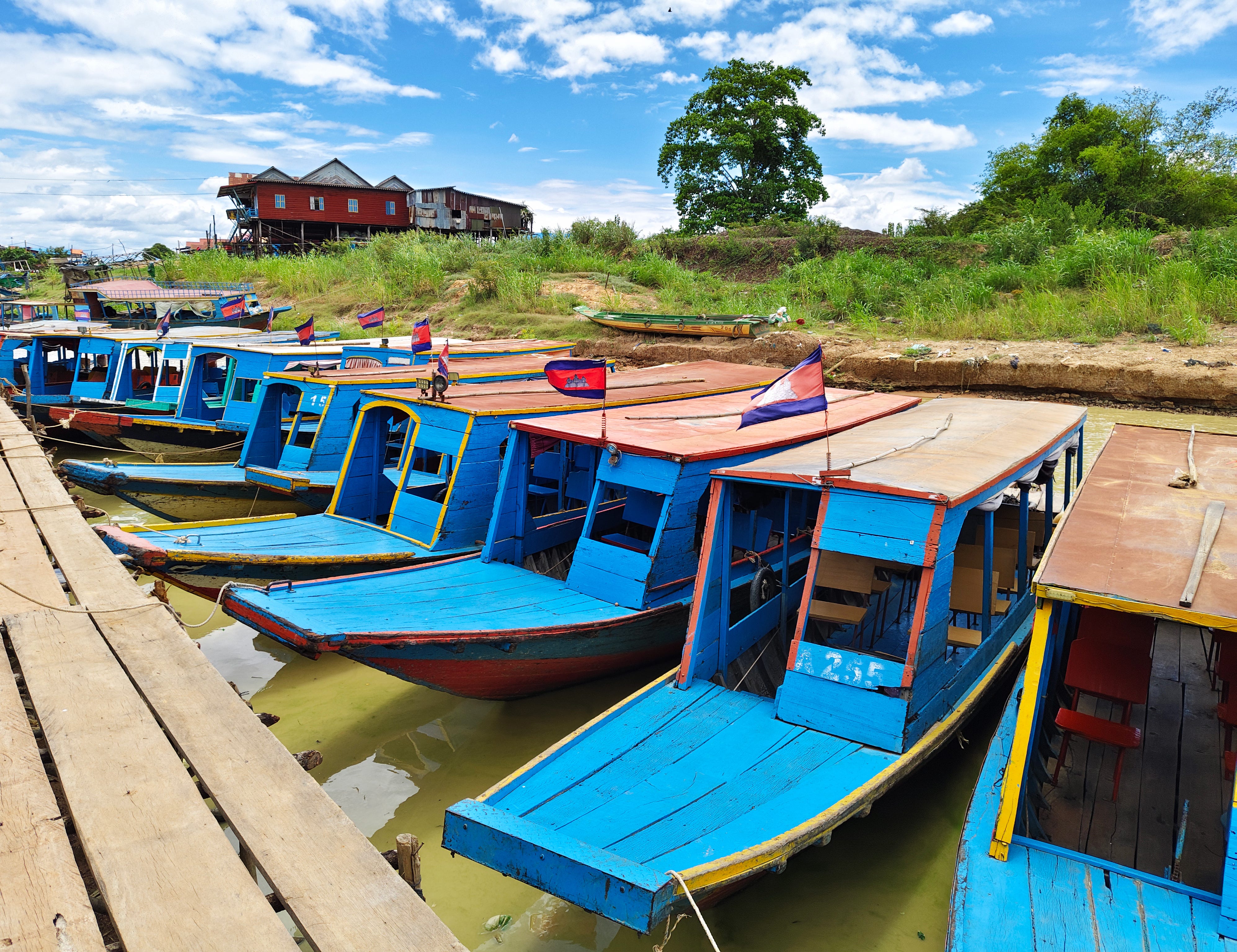
I didn’t know what kind of boat we’d be taking. Long, fairly narrow, and thankfully roofed. To my surprise it was only me, Sitha, and the boat captain onboard. We snaked through the inlet with kids swimming and fishermen casting nets while the sky was doing something cinematic overhead. On the banks, I could see the underside of the village, it felt like looking backstage at a play: stilts and bamboo structures in progress, paths threading between tall homes down to the water, bright blue and orange boats everywhere — in the water, half-sunk, propped on sticks, massive vessels just waiting for the lake to rise and make them useful again.
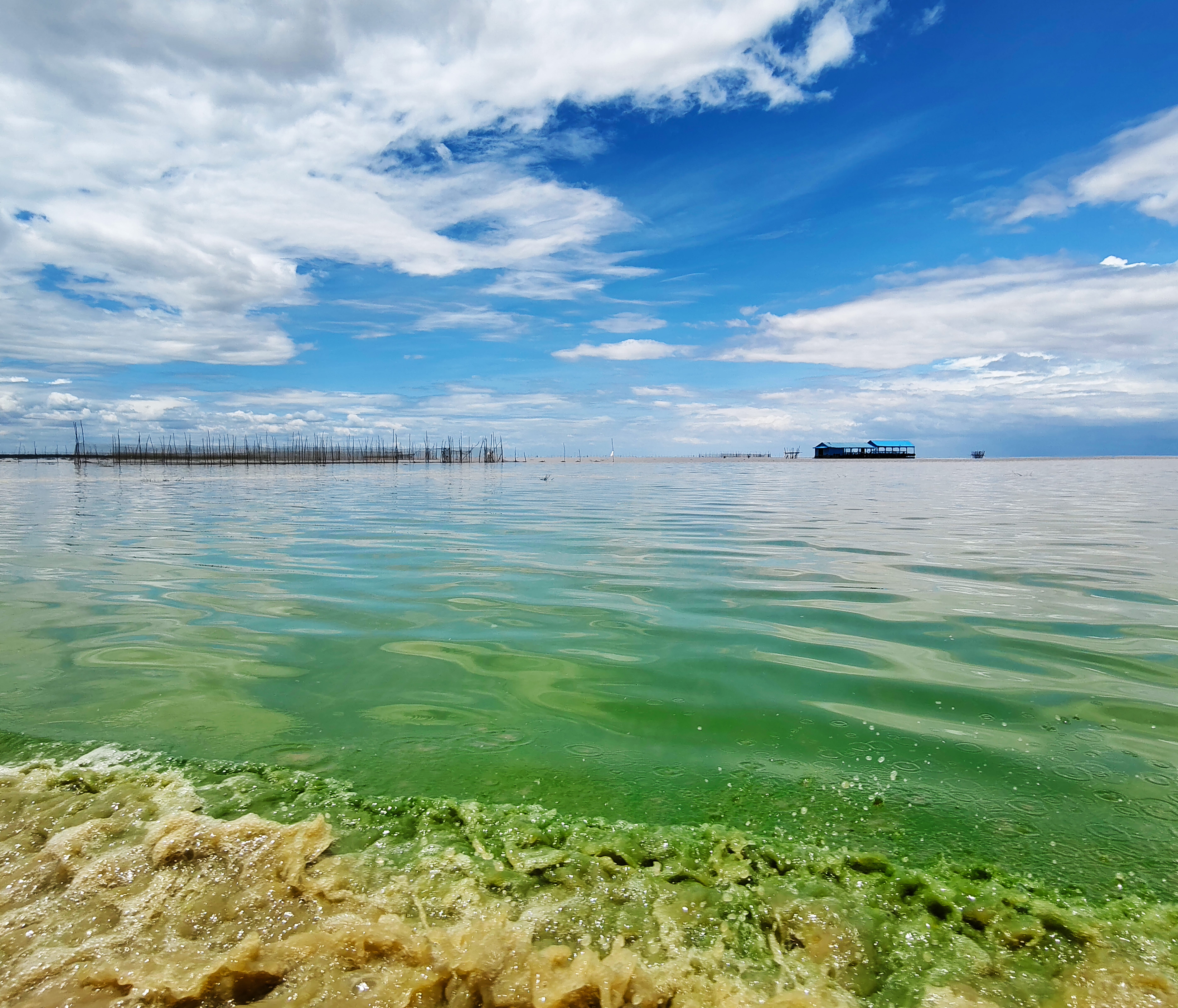
Tonle Sap is Southeast Asia’s largest freshwater lake, and seeing it from the water made that register in a way it hadn’t on a map. It’s vast, almost comparable to standing on the shore of Lake Michigan with no land visible across the surface. In the green season it swells to five times its dry-season size because the Mekong River actually reverses direction and pushes back into the lake. A literal heartbeat. We could see fishermen standing far out from shore with the water reaching only their mid-torsos, which from where I sat looked so bizarre.
Our boat dropped us at a floating restaurant. I had an omelet and a fresh coconut. Sitha had chicken fried rice. A squall moved through and the people seated at the water’s edge scrambled. It felt, briefly, like exactly where I was supposed to be.
The boat captain parking us back at the dock deserves its own paragraph. The dock was packed — a solid mass of tied-up boats with no obvious space. I watched this man inch forward, run out to the bow, push the boats on either side apart with his whole body, run back to the wheel, nudge us forward another foot, and repeat the whole sequence until we were, impossibly, parked. I recorded it and I still don’t entirely understand what I witnessed. He earned his tip.
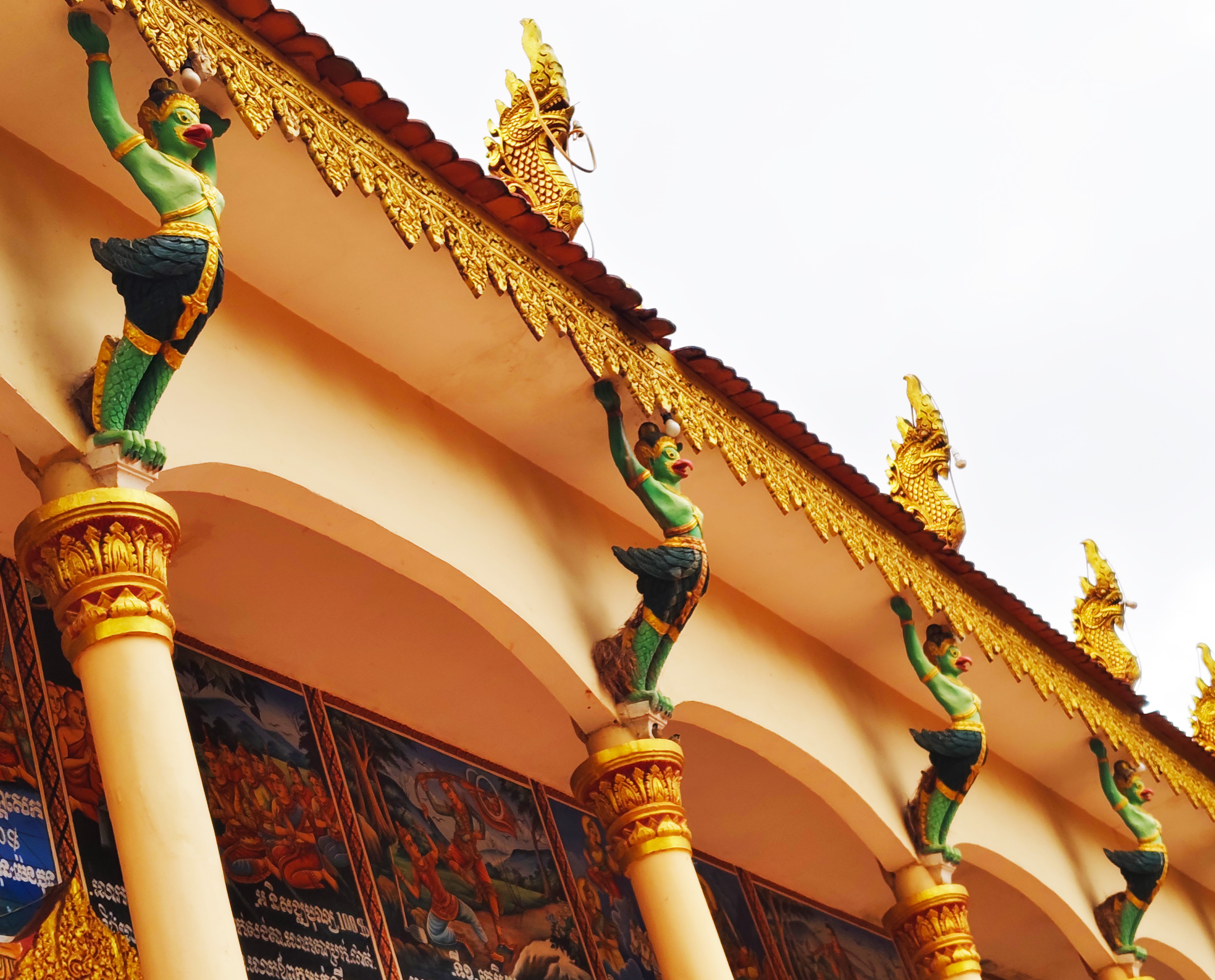
We crossed to visit the temple on the other side, where our eight-year-old entrepreneur was back at his post, bracelets in hand.
No, sweet boy, not today. But thank you again.
I wondered, walking away, if I should have bought one. The moment passed. These small ambivalences are part of traveling — the things you don’t do and spend ten minutes quietly reconsidering.
Then we headed toward the festival.
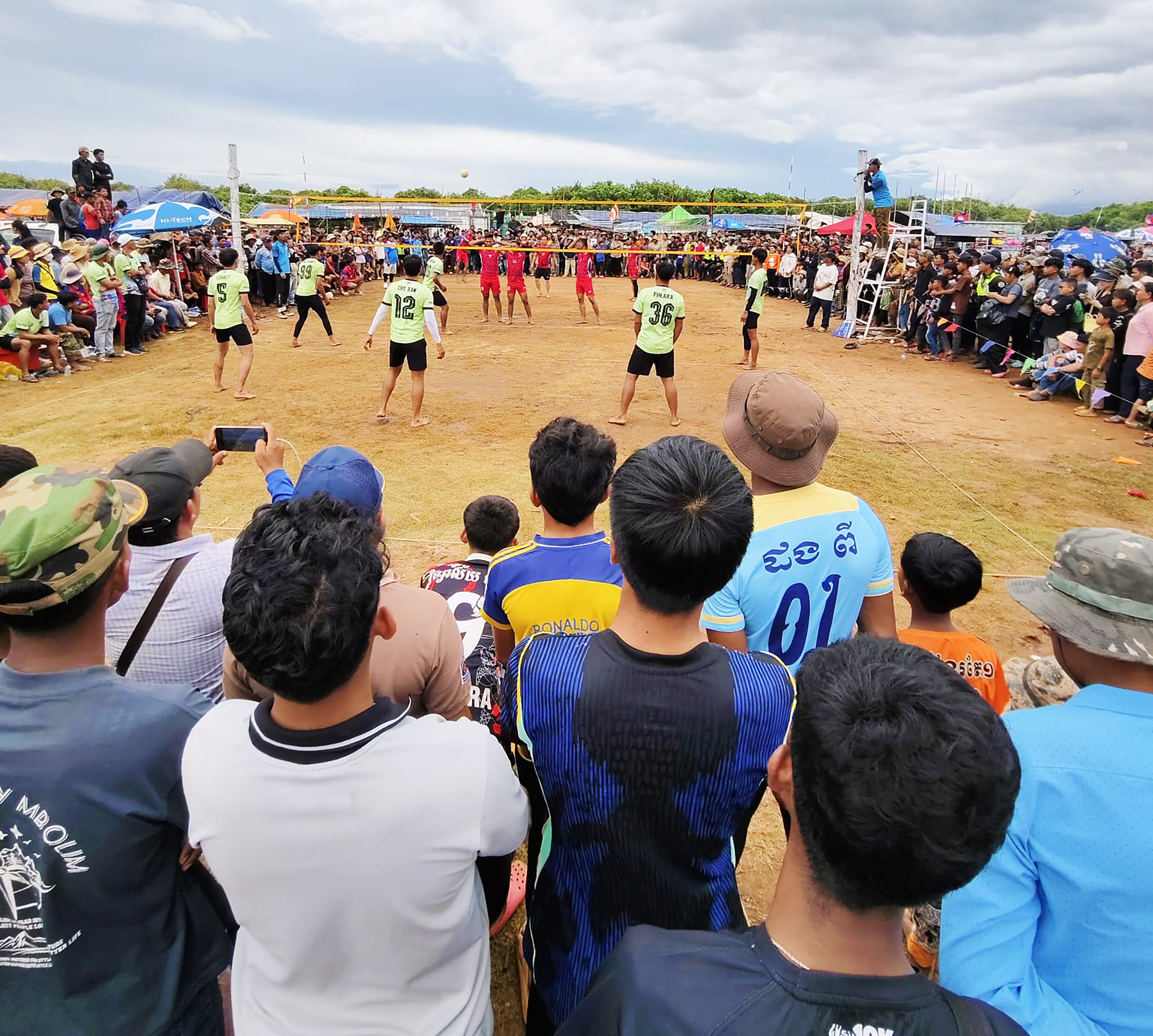
I had no idea what a Cambodian River Festival looked like. What I found at the epicenter was the most wholesome thing I could have imagined: a volleyball game. Teen girls first, competing with absolute seriousness while the crowd leaned in around them. Then the older boys, their spikes sharp enough that I ducked behind the people in front of me too many times to count. Sitha and I made a bet — I took the green team, he took blue. The Cambodian sun, even through cloud cover, had by this point decided it was done with me, and my arms and face were not just red, they were RED-duh. We left before the final game.
On the way out we ran into Sitha’s wife and one of his daughters, who hugged me around the waist. This is not the first time a Khmer woman has done this. It’s so genuinely sweet, though I will admit it makes me feel slightly like Santa Claus, and I find myself suddenly self-conscious about the size of my waist. I count it as a win that they could reach all the way around.
We left at exactly the right moment. Droves of people were flooding in as we pushed out — the same narrow road, opposite directions, traffic directors who looked like they were making their peace with chaos. What struck me, as it strikes me every time I leave my apartment, is how it resolved itself. No rage, no escalating horns, no performance of priority. Just patience. Just people letting each other through. There is the occasional cutter of lines but everyone lets them slip by making it a non-issue.
I started recording the crowd coming in. Before my phone was even out, the kids spotted me and waved hello and half the adults gave me big smiles. I was — as far as I could tell — the only foreigner at that entire festival. If another westerner was there, we never crossed paths.
This isn’t a new experience for me here, and it doesn’t unsettle me. But it does start a conversation inside my own head that I haven’t quite finished yet. At the festival, people looked at me with curiosity, sometimes surprise, occasionally something harder to read. But almost every look eventually became a smile. The Khmer people are non-confrontational in a way that isn’t distance, it’s more like discretion. Once they feel comfortable, the questions come, and they’re real questions, and I love the exchange.
I have just as many questions back.
That’s the thing about a day like this one. You go looking for baby water buffaloes and you come home carrying something heavier and harder to name — the sensation of being an outsider who was, again and again, met with welcome. I don’t take that lightly. I don’t think I ever will.
Be sure to subscribe to keep up with my travel through An Idea of a Plan.
Thank you for reading!
If you laughed, got uncomfortable, or quietly Googled water buffalo — consider buying me a coffee. It's how this keeps going.
Oh, I just love this. What an adventure of a life you have, and to do it with a fickle stomach? I have IBS, and that keeps me terrified to take long trips (or any trips) because it just shows up when it feels like. Accommodating it in a foreign country sounds impossible to me. But, I’m so jealous. The animals, the people, the culture….ugg….you are truly living and I want to come visit you!!❤️❤️
Thank you for taking us on a trip to Cambodia! This was such a vivid read. What a beautiful adventure.